
Where storytelling meets travel
“You can buy a trip somewhere, but you will never normally gain access to the collective imagination of another culture…” We explore where storytelling meets travel with Moroccan storytelling expert, curator, and Epic collaborator, Zouhair.
When journalist and writer Richard Hamilton wrote ‘The Last Storytellers (tales from the heart of Morocco)’, his idea was to preserve and share the storytelling tradition in Morocco. The storytellers in the ‘Big Square’ in Marrakech were getting older, and he saw the opportunity to capture these verbal traditions before they potentially disappeared, replaced by phones and YouTube. The book holds 36 stories handed down over time. Since it was first published in 2011, far from disappearing, there has been a storytelling revival, with a new generation of Moroccans widely sharing old and new narratives.
Zouhair Khaznaoui , or ‘Zouhair the Storyteller‘ as he is known, has played a pivotal part in that new wave. More than a storyteller, he is also a curator and creative, working with Epic on diverse experiences that extend beyond storytelling dinners into immersive storytelling experiences that become part of a journey. Zouhair is co-founder of the Marrakech International Storytelling Festival and president of the Storytellers Union. As part of this collective, he has also helped set the world record for the longest storytelling performance.
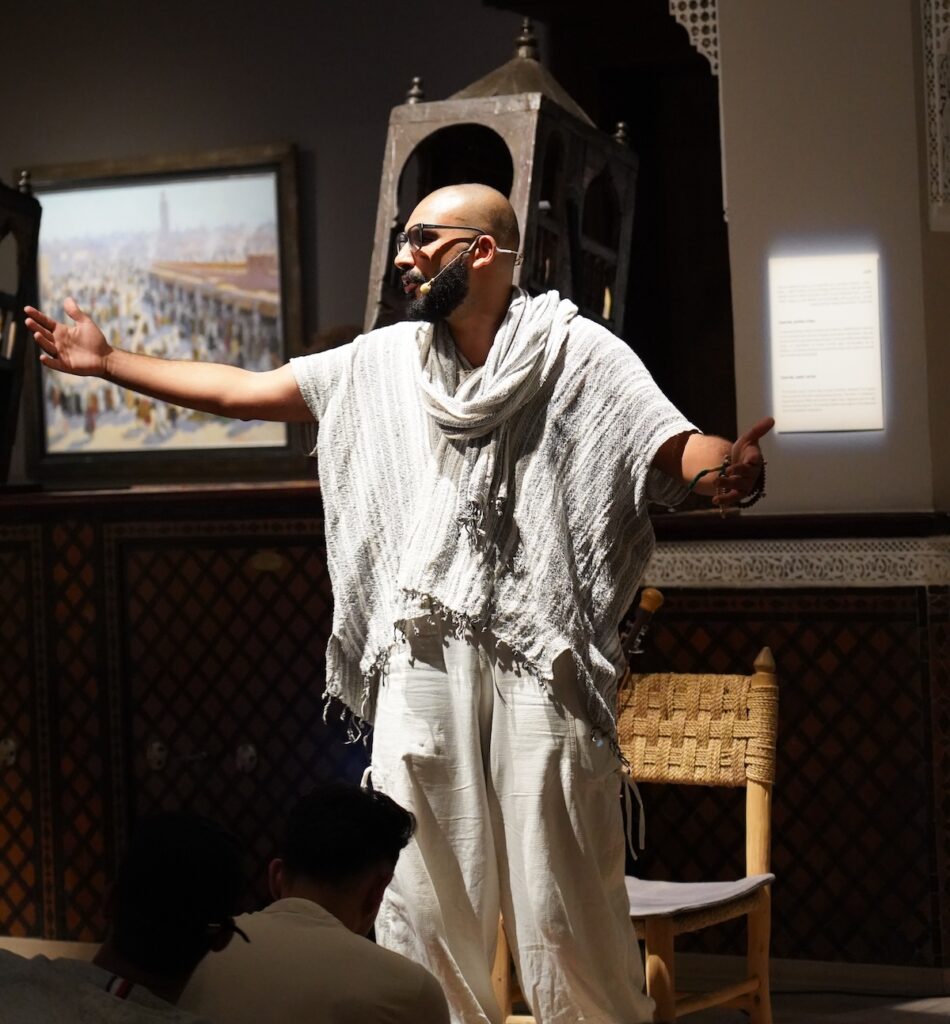
We took the opportunity to catch him during a storytelling event focusing on the history and art of tea at Marrakech’s 1112 Tea House to ask him a few questions about what he does and why he is so passionate about it.
How did you first become a storyteller?
“When I was a kid in school, I was labelled as ‘the class clown’, but later when I got to university, I realised I could use this talking and entertainment skill as a public speaker, I developed an interest in it. One day when I was speaking at a student conference, one of the other speakers, a friend of mine, said I might enjoy being a storyteller. She told me about the programme at Café Clock in Marrakech for storytellers; it was supported by Haj, a man advanced in years. He was training young people in the art of storytelling before he and the stories died out. I went to him – I kissed his hand and his forehead, and that’s how we began – I told him I wanted to become an apprentice, and he said, ‘Marhaba’ (welcome). That was a while ago, sadly he passed away in 2022.
What did you study before this?
“In Marrakech, I studied English Literature, and then I moved to Germany to study Political Culture. I studied in very good universities, I met great, influential Professors, but I never met anyone like Haj. He teaches in the traditional way, which is at the same time very modern, because he never tells you what to do…he gives you the chisel and the hammer and tells you – there is a statue inside of you, and shows you how to carve your own style. You only copied him for the first two or three months to get confidence up; then it’s up to you. He just guided you, knowing that all that he would teach you was already within you. Once you find it, you have ownership of it; it’s yours – that’s quite interesting.
What was the role of storytelling in the old days?
“Since the beginning of the world it has been an essential thing, and it’s in all religions; I call it a ‘shoreless sea’ ”
Actually, the common perception of storytelling is that it has to do with the ‘old days’, but actually it’s about now – it talks about the past, but the creation of imagery in your head is happening right here, right now. And I used to think storytellers take you back to the past, but actually they take you back to your own body, your own soul, and they give you something the world is trying so hard to deprive you of, which is a dream.
I’m not talking about a physical dream but imagination – you have ownership over it, we give the audience back their dreams for a while.
Since the beginning of the world, it has been an essential thing, and it’s in all the religions; I call it a ‘shoreless sea ’; it doesn’t have a limit. If you go back to all religions, they all start with a story: Christianity and the phrase ‘Let there be light ’; in Islam ‘kun fa-yakūn’ (let it be and there was) and in Hinduism, the ‘Om’ sound, the divine breath; and in old Aramaic, it’s ‘Avracadabra ’, I create as I speak. So, speaking and telling a story, you are reshaping reality. It was important, it is important, and it will always be important.
Richard Hamilton – says in his book, in the old days, ‘Many people lived without love, without shelter, but none of them lived in silence’ The moment you stop telling stories is the moment you die.
What do you enjoy most about your job?
Looking at the audience at the end of each storytelling session. Not everyone will be inspired of course; not even prophets could do that. But those few people you meet, and you see a sparkle in their eye after telling a story…it’s priceless.
That happened recently for a group of wellbeing female visitors here in Marrakech, there was one guy in the group a Gen Z, and he was the most hooked – something in him changed that day, and he came and found me and, like a kid, said, ‘do you have another story you want to tell me’, and I thought ‘, this is why I want to keep doing this, because in the middle of all that is happening in the world, if I get people to dream and escape for one hour its worth it’.
The pre-judgement of storytelling is that young people won’t enjoy it – attention span, etc, but I find they listen for one reason – young people don’t like someone to dictate to us, but storytelling is a softer way to communicate, and I let them imagine who the character is, what they look like, their creed, etc so in storytelling there is no dogma.
What’s the most creative thing you’ve done – a real challenge?
There are three different projects that really inspired us:
A special treasure hunt for a family group VIP’s in Marrakech, it was simple in execution, security was complicated of course, but the feeling was that we were playing with our friends, that we enjoyed it as much as the audience. We expected 12 people but ended up with 38, adults and children, it was magical – there were no barriers, it was a lot of fun.
A special occasion for a lady; it was a gift for her birthday: a storytelling of her life acted out by our team and her friends; we created an entire universe for them. The audience were part of it, so we were all participating in it, very interactive. We have a lot of actors involved, and both the actors and storytellers are great at improvising and working with live audiences; we quickly get something out of them. Something very bespoke; you can’t create that for anyone else. It was one of the most unique experiences in their life.
We also did an Aladdin inspired storytelling treasure hunt designed with Epic around Morocco; in each city, you find clues and interact with local planted actors and guides. It means the trip is immersive and enjoyable, but also the visitors have a mission which bonds the group together from the beginning to the end and unique memories and experiences that go beyond the standard travel experience.
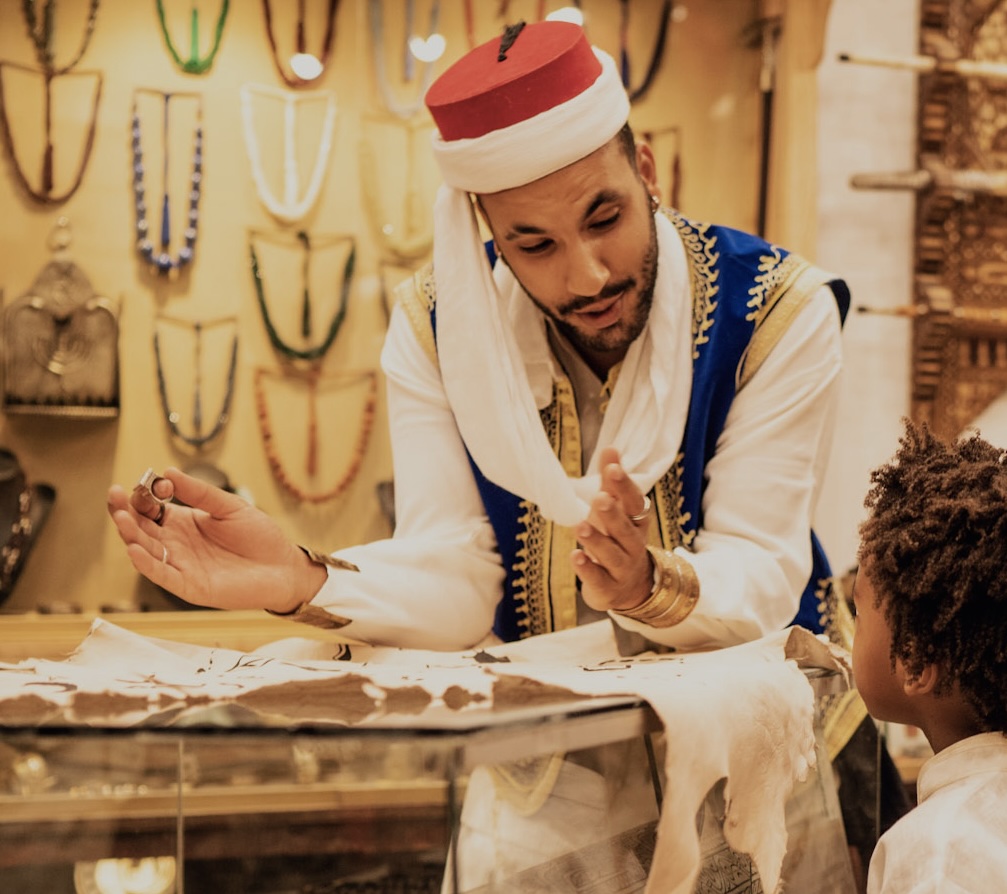
Zouhair also worked with Epic Travel on the on-site storytelling and curation of the ‘Marha Triangle Experience’, telling the story of the architect and his wife who built the three iconic and monumental structures on desert plains near Erfoud.
Parting Thoughts
Storytelling is a rare currency
“For years, other people were telling our stories in Morocco now we are telling our own story”
The one who controls the story has the power. For years, other people were telling our stories in Morocco, but now we are telling our own story, the voices of our country. This is us, giving you access, a rare currency. You can buy a trip somewhere, but you will never normally gain access to the collective imagination of another culture. We try to give that, even for a little while, to see us from within and not from the veneer. Sometimes the medina, for instance, can feel like Disneyland, unless a storyteller tells you about a window, for instance and who looks out from that window; you’ll always just see what is obvious.
All over the world, we need to listen to storytellers – there are 8 billion people but not more than 2,000 professional storytellers around the world, making tremendous efforts to keep the memory of people through telling their stories.
If you’re interested in reading more about Morocco’s stories, you can find these books on Amazon:


Amazigh Folk Tales – Tahir Shah
Read more about Zouhair in National Geographic